
Mass protest is a long way from revolution.
The people of Iran have been here before. In 2009, over perceived electoral fraud; in 2019, over fuel prices; in 2022, over the abuses of the morality police.
The authorities have honed their playbook, through the thuggery of the revolutionary guard and the Basij militias, the killing of protesters, mass detentions, public executions and the shutting down of the internet.
That last point is hugely significant. It means that people don't know if anyone else is going out.
They can't connect. They won't know whether it's worth continuing to stick their heads above the parapet after the last two nights of protest, which had been signposted and communicated in advance.
The videos they'll see are those on state TV where they'll hear the threats to use the death penalty on protesters dubbed 'vandals' or 'terrorists' and see pro-government crowds, and tempered but still sinister crackdowns.
It is hard to keep momentum going across Iran's 31 provinces, especially a protest with no apparent leader (at least within Iran itself), if people are left in an information black hole.
Reza Pahlavi, son of the former shah, clearly has some support on the streets, but he is in the US, and his calls for strikes and further protest may have problems filtering through.
And of course, the shutdown allows the authorities to crack down as they choose, without the visibility that connectivity would confer on them.
That's what happened in 2019 when at least 1,500 protesters were killed. We are still a long way from those kinds of numbers, although given the scarcity of information, it is hard to tell.
The one barrier to the regime extending that blackout indefinitely is the economic toll it will take on an already gasping economy.
But there is a long way to go in terms of how much they could crack down, and they have shown no sign of relenting.
Revolutions would require elite buy-in - for elements of the security apparatus to decide that continuing to defer to the 86-year-old supreme leader no longer makes sense. That doesn't look like it's happening either.
Read more:
Who is Iran's exiled crown prince?
Most serious threat since 1979 revolution
The wild card is Donald Trump. He has promised to hit Iran hard if the regime opens fire on protesters. And then there is Israel, too, which might take the opportunity for another strike.
Iran's Islamic theocracy is more vulnerable than it has ever been. But it was born of a revolution itself, and the Supreme Leader Ayatollah Ali Khamenei is not about to show weakness.

(c) Sky News 2026: Iran's regime is more vulnerable than it has ever been, but Khamenei shows no sign of relenting
 US military carries out large-scale strikes against Islamic State targets across Syria
 There's a daily game of cat and mouse to catch illegal migrants in Germany - and it may soon become UK's problem
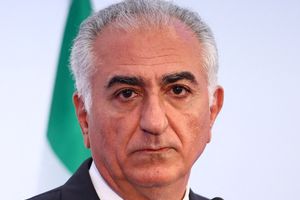 Reza Pahlavi: Who is the exiled crown prince positioning himself as a key figure in Iran's future after decades away?