

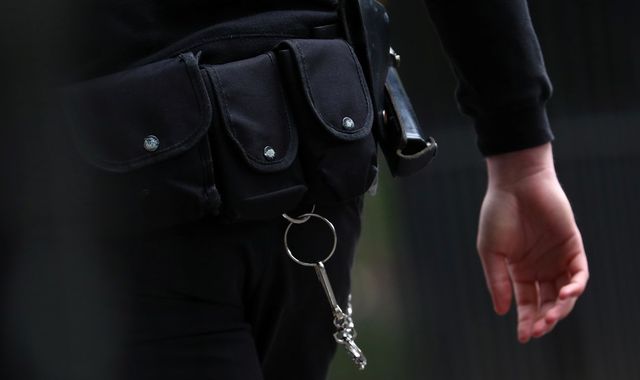
If you've ever spent your morning commute daydreaming about starting afresh with your career, this feature is for you. Each Monday, we speak to someone from a different profession to discover what it's really like.
Recently, we spoke to a prison officer working in a British prison. To allow them to answer their questions honestly, we've kept them anonymous...
Salary tends not to be something most officers focus on... I believe the national pay for prison officers is more than £34,000. It could be more depending on where you work, benefits and hours as well. We mostly work 37-hour weeks, which is the default. We then have 39- and 41-hour weeks, which come with additional pay.
We are underpaid... for the level of risk and complexity we manage every day. The government accepted the Prison Service Pay Review Body recommendation for 2026-27, giving prison staff only a 3.5% pay rise, a small increase that doesn't match inflation or the rising demands of the job.
Money blog: Read the latest consumer and personal finance news
The prison system relies on... officers working beyond their actual contracted hours. It sometimes also requires officers to come in on their days off to help. Officers are immediately impacted by jails exceeding safe capacity. You are frequently asked to stay late, cover gaps and put in extra work to maintain wings due to ongoing congestion and staff shortages. Overtime is no longer considered an "extra"; rather, it is an integral part of jail operations. Because the effort and intensity rarely lessen, the outcome is longer hours, unpredictable shifts, and a job that mentally follows you home.
You get an initial two-week training in your establishment... then seven weeks in school or college, then another three weeks of consolidation training back at your establishment. That makes a total of 12 weeks. Sometimes, it feels more than enough. Other times, it feels not enough. The on-the-job training is forever; every day is a learning curve. I knew it would be a tougher-than-ordinary job, but I didn't understand the nitty-gritty until I got in.
Prison officers in the UK are widely seen as one of the most forgotten and under-recognised frontline services... Much of the work happens out of public view, so society rarely sees the danger, pressure, or emotional strain involved.
Anyone looking to become a prison officer should have courage... and determination. It helps a lot on the job. You also need to have good interpersonal relationships if you want to survive in this job. That is one skill that people underestimate.
People often talk about the physical stress, but we deal with trauma, conflict and manipulation... yet you are expected to be professional, stay calm and resilient all the time.
Key to surviving as a prison officer is... interpersonal relationships, both with staff and prisoners. Emotional control is everything. You quickly learn that you cannot take anything personally and you also need to have empathy.
One of the most memorable moments of my job was... helping a prisoner who had become very isolated and rarely left his cell. He lacked confidence and did not want to engage with anyone. By building a positive relationship with him, encouraging him and helping him access support, he eventually started attending education classes and the gym. Over time, he gained confidence, developed new skills and became much more involved in prison life. Seeing the difference in him was incredibly rewarding. His attitude, outlook and prospects completely changed, and it reminded me how much of an impact prison officers can have on someone's life.
I have been subjected to three separate assaults, all involving the throwing of unknown liquids... These incidents have been profoundly distressing, and the emotional impact is something I would not compare to any other experience. The most serious incident was instigated by a prisoner, who had been refused his medication by healthcare staff, as he had reportedly taken an overdose the previous night. The assault occurred during unsocial hours, and it became clear that the prisoner was attempting to use the medication round as an opportunity to leave his cell. I approached his door and calmly explained the nurse's decision. Shortly afterwards, another prisoner falsely informed him that I had instructed healthcare not to issue his medication. The situation escalated rapidly. The prisoner began aggressively banging on his door and damaging his cell. He broke his observation panel and, through the opening, threw an unknown liquid at me. The smell was extremely unpleasant, and the shock of the assault was severe.
What is particularly concerning is the limited consequences for such behaviour... The primary response has been to keep the prisoner behind his door, which does not reflect the seriousness of these assaults.
It is disheartening to acknowledge that within this establishment, prisoners appear to have gained significant control over the environment... making it increasingly dangerous and challenging for staff. Support for officers is insufficient, and this is the same across most estates. In my view, certain individuals are overindulged in ways that compromise safety and authority.
My first assault experience was especially demoralising... My line manager did not ask how I was coping, nor offer any meaningful support. When I requested a change of uniform, I was given a dirty, foul‑smelling replacement. Despite being entitled to leave, I chose to complete my shift. The following day, instead of receiving support, I received an email from my line manager criticising me for not completing Accommodation and Fabric Checks.
My second assault was a direct result of severe staff shortages. On that particular day... prisoners were kept behind their doors for the entire morning, and they were only allowed half an hour out in the afternoon. We were only four officers, including the supervising officer, responsible for managing over 180 prisoners. The wing I work on is one of the largest in the establishment and is divided into two separate units: the vulnerable prisoners' unit and the lifers' unit. On the vulnerable prisoners' side, approximately 95% of prisoners are on daily medication. Due to the staff shortage, the entire wing was placed on lockdown, and we had to medicate each prisoner individually. With only four officers available, two officers were assigned to each side. The process was extremely demanding: we unlocked one prisoner, escorted them to the medication hatch, then locked them back in their cell before unlocking the next person. This continued for the entire morning and afternoon because some of them are on both morning and afternoon medication and we had to do controlled feeding as well. The pressure and stress were overwhelming. During this period, there were multiple incidents of self‑harm, prisoners smashing their cells, and individuals climbing onto high points within the wing. The environment became increasingly volatile and unsafe.
More from Sky News:
How to challenge your council tax band
Under-16s Vinted and eBay ban considered
Are data centres good or bad for the UK?
There are three major misconceptions about the role as a prison officer that I wish the public understood...
- First, many people believe we simply "supervise prisoners" when in reality the job involves safeguarding, conflict resolution, rehabilitation support, emergency response, and constant risk management.
- Second, there's a common assumption that the role is mostly physical and only requires toughness, but the real challenge is psychologically staying calm, consistent and emotionally controlled in an environment where behaviour can change in seconds.
- Finally, people often think prison officers receive the same recognition and support as other uniformed services, yet much of our work happens behind closed doors, making us one of the least visible and least acknowledged frontline professions despite the high level of responsibility and risk we carry every day.
My experiences as a prison officer have taught me that... people commit crimes for various reasons. Some have committed crimes with premeditation, some have done it by mistake, some feel sorry for it and would not likely reoffend, and some are a ticking bomb waiting to explode for their next crime.
Most prisoners can earn money through... prison work, education, or training activities. The amount varies depending on the establishment and the activity. If a prisoner is unable to work or attend activities for an accepted reason, they may receive a basic allowance. Family and friends cannot usually bring cash into the prison during visits. Instead, money can normally be sent through approved methods, such as an online payment service or bank transfer, depending on the prison's procedures. The money is then credited to the prisoner's account.
If I could tell my 16-year-old self anything, it would be... be strong, courageous, selfless and, more importantly, never underestimate yourself.
Money contacted the Ministry of Justice for a chance to respond to the prison officer's view of the job.
A spokesperson said: "Prison officers do vital work, supporting the rehabilitation of offenders whilst ensuring the public are safe. We are backing them with higher pay, better protective equipment, improved training and development, and action to boost recruitment and retention. Prisoners who assault staff will face the full consequences of their actions.
"But we are not complacent, and former home secretary Amber Rudd is leading an independent review to help deliver safer prisons and cut reoffending."

(c) Sky News 2026: Shocking attacks, overtime and overwhelming pressure: Reality of being a prison officer
 Retail sector charity refuses to back Poundland owner's boss
 Thames Water agrees funding into next year ahead of November deadline
 Funds giant DE Shaw in talks to back £7bn digital bank Monzo